
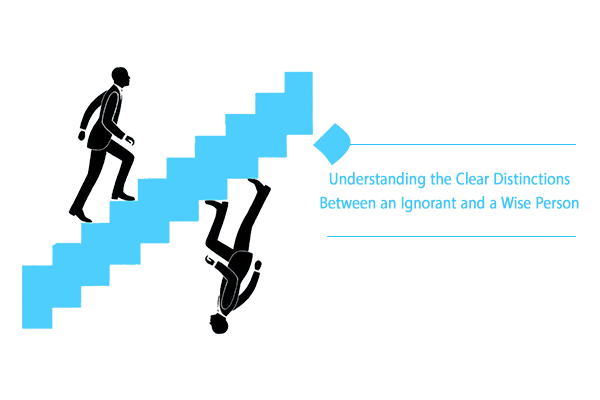
What Is the Difference Between an Ignorant and a Wise Person?
In your opinion, who is called wise and who is called ignorant? What is the measure and value system of human intelligence? Is a person we call wise truly wise according to God’s measurement?
As we mentioned in previous lessons, we deal with a mathematical structure in the universe. Everything in existence has a measure and quantity [1] and follows specific rules and formulas. God is the Creator of this entire structure and has set the measures; therefore, in God’s value and measurement system, every creation has a definite rank, value, and worth, and the status of each creation in comparison with others is clearly determined. Each of us also has our own system of measurement and value. However, this system is not necessarily aligned with that of God. In other words, sometimes things become important and vital to us that are worthless to God, and vice versa—things that are valuable and precious to God may receive no attention from us.
Such a difference is not in our favor, and basically, it should not exist. Our relationship with God is like that of a mentee with a mentor. For the mentee to reach the mentor’s level, their perspective must fully align with the mentor’s view, and their steps must follow exactly where the mentor places them; otherwise, no growth occurs in the mentee. God is our Lord and our Mentor; if we truly seek to reach God and succeed ultimately, we must align our value system with our Mentor, Almighty God, and not with anyone or anything else. Even the slightest disagreement between us and God in this or any other matter is a kind of disorder that distances us from our ultimate purpose of creation. But why is this so? Why do some of us have a value system different from God’s? To answer this question, we need a brief review of humans and their existential dimensions.
The Different Dimensions of Human Existence Cause Wisdom and Ignorance
Human beings are the most perfect beings or comprehensive entities encompassing everything from matter to the Infinite Existence, Allah. The existential dimensions of humans include the inanimate, vegetative, animal, intellective, and supra-rational dimensions. Each of these dimensions has pairs which are compatible with and in harmony with them. Humans differ in which dimension dominates their existence, usually according to lifestyle and morale. For example, some people love beauty and inanimate perfections such as precious stones, jewelry, and luxurious items. Some delight in achieving vegetative perfections such as beauty of face and body. Others seek animalistic perfections such as power and status, and some enjoy scientific and intellective perfections. A rare few reach supra-rational maturity, where their attachments attains human value.
All perfections have their own worth, but none equal human perfections. The definition of a human being is clear: a being superior to all others, created to achieve human perfections. Therefore, their most valuable life goal must be acquiring these perfections—not superficial or lowly perfections. To illustrate, the purpose of a student’s presence at university is to gain knowledge, which is the most valuable perfection the student should acquire. The student does not attend university primarily for exercise, meals, or trips. He goes to university to increase his knowledge. However, during this education, he also engages in other activities. These activities are necessary for him, but they are not the main goal; in other words, in a place like a university that is designed for education, the value of acquiring knowledge is not equal to the value of entertainment. Therefore, a student who values entertainment more than learning is ignorant and lacks wisdom. The world is also an educational place, designed by God for our training. We were not born to pursue inanimate, vegetative, animal, or even intellective perfections alone. Thus, anyone who values these more than human perfections is an ignorant person whose value and measurement system differs greatly from that of their Lord and Mentor, God. Next, we will become more familiar with God’s measurement system and that of an ignorant person.
According to God’s View, Who Is Considered an Ignorant and Who Is Wiser?
We said that God is the Creator of all measures, and because He encompasses all existence, His measurement and value system is the truest. We are supposed to move toward God; therefore, reason dictates that we regulate our lifestyle according to God’s scale, not according to baseless and fabricated criteria. We should not allow animalistic desires to influence our intellect and distance us from divine standards.
A person whose intellect is governed by their desires is ignorant and constantly makes errors in making decisions and establishing relationships, preferring worthless matters over valuable ones. If asked to choose between two bags containing one million tomans and one billion tomans, surely, we all choose the bag with the higher amount; if someone chooses otherwise, we doubt their sanity. Yet, many of us act as if choosing the smaller amount when it comes to matters related to our human and eternal life. It is that naive!
But what is the reason? Because we do not know the values. When buying expensive goods for our home, almost all of us shop around to avoid being cheated, but unfortunately, we have no such sensitivity about ourselves. We sell our soul—the greatest capital and our only asset—at a very low price because our value system is far from what it should be.
Prophet Muhammad (Peace be upon him) defined intellect by saying, “Intellect is that by which Paradise is attained and the pleasure of the Lord is sought [2].” This apparently simple statement contains immense meaning; the Prophet draws the boundary between wisdom and foolishness and gives us a well-ordered value system. According to this, to measure someone’s intellect, we should see what they pursue in life and at what price they trade their lifetime. Do they seek eternal, everlasting pleasure or fleeting, limited joy? Reason dictates preferring lasting pleasure over temporary pleasure; so, anyone who prefers the transient, limited world over eternal heaven is an ignorant person.
In God’s measurement system, this world is a pastime and a play, and true life is in the hereafter [3]. God has placed only one percent of His mercy on earth and reserved ninety-nine percent for the hereafter [4]. In heaven, pure blessings await the righteous that no eye has seen, no ear has heard, and no human mind has imagined [5]. Now imagine someone who abandons all these blessings and clings to the insignificant refuse of this world, which is with them only briefly—are they not an ignorant and short-sighted person?
In the Quran, God repeatedly uses phrases like “they do not reason” and “they do not understand” [6] for worldly people, sinners, and generally those whose value system differs from God’s. He calls them animals, lower than animals [7], stones, or harder than stones [8], or describes them as deaf, blind [9], and foolish [10]. Note that these are not insults; God does not intend to degrade people’s personalities but states their truth and value. According to God’s value system, anyone who prefers worldly life to eternal life is worth no more than a stone, wood, plant, or animal.
Another sign of intellect mentioned by the Prophet (Peace be upon him) is seeking God’s satisfaction. God’s pleasure surpasses Heaven, and only an ignorant person trades the pleasure of their True Beloved for the satisfaction of false beloveds, whose love is tainted with countless desires. Of course, aligning one’s lifestyle with God’s value system is not easy; those who take this path often face ridicule and mockery from worldly people [11]. But anyone who has discovered their true value does not fear the jeers of mockers, for their view has expanded to a realm that grandeur worldly people cannot comprehend.
In this lesson, we discussed God’s measurement system and its difference from an ignorant person’s system. We said that everyone’s value system shows their degree of intellect. God’s measurement system, as Creator of all worlds, is the truest; a lack of compatibility to it indicates foolishness and ignorance. Only an ignorant person prefers something worthless to something valuable and lasting. One of the main roots of foolishness is lack of self-knowledge. When a person does not know their true self and their True Beloved, they err in judging the value and price of matters and sell their soul cheaply.
References
[1]. “Indeed, Allah has appointed a measure for everything.” (Quran, 65:3), “and everything is by [precise] measure with Him,” (Quran, 13:8)
[2]. “Intellect is that by which Heaven is attained and the pleasure of the Most Merciful is sought.” (Ibn Babawayh, Muhammad ibn Ali. Man La Yahduruhu al-Faqih, vol. 4, p. 369)
[3]. Quran, 29:64
[4]. Salman reported that prophet Muhammad (Peace be upon him) said:
“Verily, Allah created, on the same very day when He created the heavens and the earth, one hundred parts of mercy. Every part of mercy is coextensive with the space between the heavens. and the earth and He out of this mercy endowed one part to the earth and it is because of this that the mother shows affection to her child and even the beasts and birds show kindness to one another and when there would be the Day of Resurrection, Allah would make full (use of Mercy).” (Sahih Muslim, Book 50, Hadith 25)
[5]. Prophet Muhammad (Peace be upon him) said:
“Allah said, “I have prepared for My righteous slaves (such excellent things) as no eye has ever seen, nor an ear has ever heard nor a human heart can ever think of.” (Sahih al-Bukhari, Book 97, Hadith 123)
[6]. “They do not reason”, “They do not perceive”
[7]. Quran, 7:179
[8]. Quran, 2:74
[9]. Quran, 2:171
[10]. Quran, 2:130
[11]. Quran, 83:29-30