
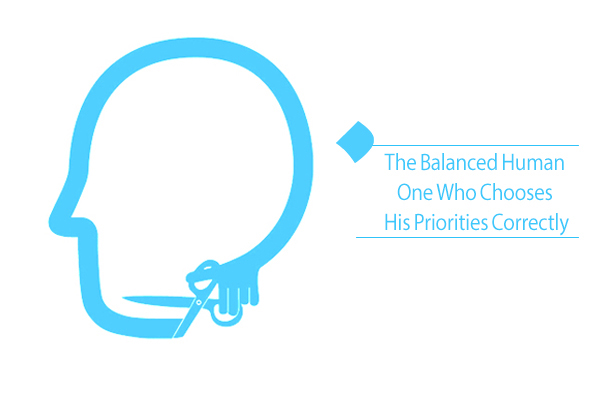
The Characteristics of the Existential Structure of a Balanced Human
If we are asked to describe the body of a balanced human, we will definitely answer that it is the body whose every part is in its own place and it obeys the center of decision-making and command of the body, i.e., the brain. We often do not see a body as balanced if the head is not the right size compared to the rest of the body or if the eyes, ears, and hands are in strange places. Being balanced has its own rules, and something that fits into these rules is naturally called a balanced thing. As we know, our souls like our bodies and other phenomena of creation have a mathematical structure, so it is not strange that just as we consider a state of balance for our bodies and evaluate their balance or imbalance with it, we consider such a state of balance for the structure of our souls as well.
Just as a car that is not well balanced cannot drive in a straight line, or a building without balance may collapse at any moment, an unbalanced human shows symptoms of his imbalance in some way. In fact, most of our spiritual and physical illnesses stem from imbalance in our souls or bodies, and as soon as balance is restored, they are treated. Perhaps in material and outward things only the manner and order of arranging the elements of something are sufficient to establish balance, while in the case of something like the soul, prioritizing and focusing on every dimension of our being is important. As we learned in the previous lessons, as long as all the dimensions and faculties of our existence are not under the control and sovereignty of our supra-rational faculty, we are unable to establish balance in our souls and become a balanced human. In this lesson, we intend to understand how focusing on every dimension and faculty of our being helps us to find balance.

Characteristics of Different Beings
In our surroundings, we interact with beings that, based on their existential structure, have a level or levels of existence. For example, we attribute the inanimate dimension to stones and metals because they only have physical bodies and elemental properties. So we distinguish between plants and stones because plants, in addition to having elemental properties, have beauty and are capable of growth, absorbing nutrients, reproduction, etc. In the same way, animals, in addition to having the characteristics of plants, have capabilities that place them in a higher level; for example, they have social life and strive to climb the social hierarchy. Although angles do not have inanimate, vegetative, and animal dimensions, they enjoy intellective faculties that put them in a higher level than animals.
Since the human being is the noblest creation, he not only has all these faculties, but he also enjoys the human or supra-rational dimension that puts him in a higher level than each of these beings. But the point is that merely having the form of a human is not sufficient for being a human. We do not consider a car well-balanced when it does not start or when its steering wheel turns in the opposite direction, even if it is in a good shape. In the same way, if we want to be called humans, we need to develop certain conditions and characteristics. We can call ourselves humans when we pay adequate attention to each dimension of our being, or in other words, when we have reached the state of balance. It means that for being a human we must transform into a balanced human.
Loss of Balance in Various Dimensions of the Human Being
Sometimes the loss of balance is recognized through outward symptoms, and sometimes it is detected through inadequate performance. The same story goes for our existential dimensions and faculties. For example, when we care more about material possessions like our house, appliances, and belongings, and feel anxious when our bank account balance decreases, or when we value our cars more than just transportation, or get upset when something breaks, it shows that we place too much importance on our inanimate dimension and overindulge our souls with sensory forms. In this case, we are not balanced humans.
Similarly, when we focus too much on physical appearance by spending a lot of time in beauty salons or the gym, getting cosmetic surgeries, or prioritizing being in shape over our overall health, it shows we are overly dedicated to vegetative perfections. When we brag about our fertility or the number of our children, boast about being just ten centimeters taller than others, or feel down because of our looks and height, it means that we have distanced ourselves from human balance and have reduced ourselves to the level of a plant.
Distancing ourselves from the state of human balance and defining the balanced human are not limited to paying too much attention to the inanimate or vegetative dimensions of our being; we may lose our balance by focusing excessively on our estimative and animal affairs. For instance, when we give up our dreams to marry someone, focus solely on getting promoted, or spend years and money just to be called a doctor, engineer, or professor, we may become overly consumed by these pursuits. If we work tirelessly for fame or let our desires and instincts disrupt our lives, we can become slaves to our desires. In these cases, we lower ourselves to the animal level and place too much importance on our estimative faculty.
Intellective perfections, which are considered neutral in themselves, are of value only when they serve our supra-rational or human dimension. When we spend days and nights studying and doing research in the laboratory or in the research center without paying attention to the purpose of our creation, when our main concern is to publish our article in a prestigious international journal or to get a degree or a scholarship to the best universities in the world, when we just want to write a lot of books or publish multiple articles, when the desire for scientific study and research blinds us to the fundamental truths and issues of our lives, it means that we have lost balance in our human dimension. In this case, we are not considered a balanced human.
All that has been stated about our inanimate, vegetative, animal, and intellective perfections can be beneficial if we give them the attention they deserve and place them appropriately. We become a balanced human being when we achieve these perfections and respect their limits based on the desires of our supra-rational faculty. Just as we need to measure ingredients and follow a recipe to make the best food, it is unreasonable to expect to absorb any perfection without being in harmony with our supra-rational dimension and then find balance in life.
The Relationships Between Different Dimensions and Parts of the Soul
The human soul is composed of various dimensions, each of which uses a tool to fulfill its desires and achieve its related perfection. Our faculties of sense perception, imagination, estimation, and intellect are in fact tools that help us achieve the perfections associated with each aspect of our being. We become a balanced human and reach a human inward state when our supra-rational faculty controls the four lower dimensions of our being and we strive to reach the Beloved of our supra-rational dimension, i.e., Allah. Each of our faculties and dimensions strive to get control of our soul, but as Allah is the Infinite Being, we only achieve balance when we are in harmony with Him. The qualities and dimensions of our four lower parts have no access to infinity due to their limitations. In fact, we reach Allah and find balance only when we are under the control of our supra-rational dimension; in other words, we are a balanced human only when we prioritize the desire for infinity and loving the Infinite Being over other desires and beloveds.
But the point is that our faculties are good tools for our supra-rational faculty when they are fundamentally arranged in the right order. To become a balanced human being, we need to have a balanced sense perception, positive imagination, and controlled estimation and intellect. Sensory forms serve as inputs for the soul and are used as data for our imagination; our imagination aids us in estimation, and estimation is used for intellective conclusions. Just as to cook a healthy meal, we need to prepare the right ingredients and follow the recipe, achieving suitable output depends on prioritization and providing proper nourishment to other dimensions and faculties of the soul. In fact, any neglect in recognizing priorities and limits can lead to mistakes in our choices, relationships, decisions, and thoughts, ultimately preventing us from achieving balance.
In this article, we discussed how through improper choices and behaviors, we disturb our human balance and distance ourselves from being a balanced human. We are balanced humans when all the lower faculties and dimensions of our being are under the control of the supra-rational faculty and strive to reach the Beloved of this faculty, i.e., Allah. Moreover, balance will be established when we give appropriate attention to each of these dimensions and to the extent that is necessary.
Do you consider yourself a balanced human? How do you prioritize and focus on various dimensions of your being?