
What Does Religious Hypocrisy Mean, and How Does It Differ from Religious Sincerity?
In recent years, the issue of superficiality and religious hypocrisy has become a significant challenge in the realms of faith and social ethics. Many individuals, for various reasons, attempt to display religious behaviors that do not necessarily stem from heartfelt beliefs or internal values. In such circumstances, distinguishing between religious sincerity and religious hypocrisy becomes doubly important. This raises critical questions: Are those who consistently stand in the front rows of congregational prayers or actively participate in religious ceremonies necessarily devout individuals, or might they be caught in religious superficiality? Does mere adherence to religious rituals, without regard for the intention and inner reality of deeds, protect us from the dangers of hypocrisy, or not?
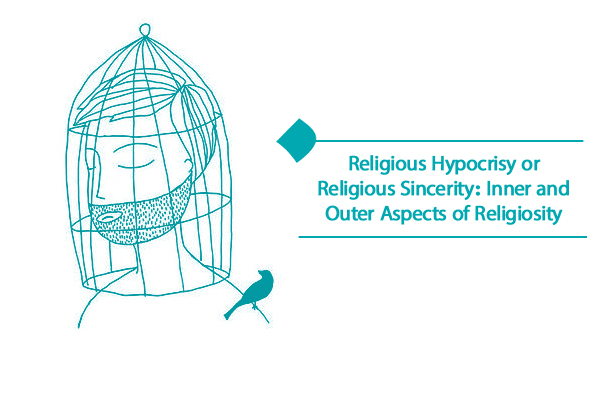
Religious hypocrisy consists of outwardly displaying religious behaviors without harmony with inner beliefs, leading to a duality between one’s character and behavior. This may arise from various factors, such as social pressures, personal desires for gaining credibility or social status, or a weakness in knowing the profound religious concepts. The consequence of this approach is a decline in public trust in religion and religious institutions, as well as harm to individuals’ psychological and spiritual well-being.
In contrast, religious sincerity is rooted in heartfelt belief, pure intention, and ethical commitment to divine commandments, guiding individuals toward self-improvement, responsibility, and sincere service to others. In this form of religiosity, seeking God’s satisfaction is the primary goal, not limited to gaining others’ admiration. In other words, religious sincerity is an internal and personal process that manifests in an individual’s behavior and deeds.
In this lesson, we aim to explore the dimensions and signs of religious hypocrisy and examine its differences from religious sincerity in terms of causes, consequences, and indicators in greater detail.
Conceptual Definition of the Action Rooted in Fisq or Religious Hypocrisy
The action rooted in fisq, often referred to in religious and ethical texts as religious hypocrisy, pertains to deeds that, despite resembling religious practices and rituals on the surface, lack the essence and truth of faith, sincerity, and love for God at their core. In such cases, an individual may perform religious rituals and present themselves as devout, but their primary motivation is not seeking God’s satisfaction or spiritual growth. Instead, their deeds are driven by worldly motives, such as gaining social credit, elevating personal status, avoiding criticism from others, or influencing how others perceive them.
In this state, religious appearances become a tool for achieving goals unrelated to human growth in the path of the purpose of creation. Consequently, prayer, fasting, participation in religious ceremonies, or even defending ethical values are no longer grounded in faith or divine intention but serve purposes rooted in seeking attention, approval, or social standing. This creates a duality between outward state and inward state. In public, the individual may present a religious or even obsessive persona, but in private, they lack a genuine connection with God and His allies or do not prioritize such a connection in their life.
What distinguishes the action rooted in fisq from religious sincerity is the type of inner motivation and the orientation of the individual’s love in performing religious acts. In religious sincerity, the motivation for all religious practices and rituals is to seek God’s satisfaction, love for God and His friends, and jihad in the way of truth.
In contrast, in the action rooted in fisq, these lofty motivations are replaced by worldly desires, a thirst for being seen, and the pursuit of social approval. In this state, even if the appearance of religiosity is maintained and the individual frequently participates in religious gatherings, their deeds lack true value in the sight of God and, in some cases, is considered an instance of practical hypocrisy.
Therefore, it must be emphasized that religious hypocrisy is not merely about performing religious acts artificially or superficially. Rather, it is a profound psychological and educational process during which the outer state distances from the inward state, and spiritual motivations gradually lose their vibrancy. The persistence of this condition may lead to personality duality, weakened faith, and even deviation from the path of religion. This poses a serious threat to both the individual’s religious upbringing and the spiritual and ethical health of society.
From this perspective, precisely discerning the signs, processes, and motivations behind religious hypocrisy, and distinguishing it from authentic faith, is a paramount concern in the domains of religious education, moral psychology, and practical epistemology. Only by moving beyond superficial layers and uncovering true motivations can we achieve an understanding and promotion of religious sincerity while preventing the harms of religious aversion and social hypocrisy.
Indicators and Signs of Religious Hypocrisy
As previously discussed, religious hypocrisy is rooted in the separation of outward state from inward state. In this part, we explore the psychological and social indicators and effects of this phenomenon. The most prominent signs of religious hypocrisy can be observed in behaviors such as performing religious rituals with the intent of gaining attention or social approval, reducing acts of worship to repetitive, meaningless gestures and words. Other symptoms include neglecting divine love and authentic Islamic values in fundamental life decisions, and as well as the formation of a duality between an individual’s public and private persona. In all these cases, the central and common element is superficiality and the prioritization of the outward state over the inward state.
In such cases, religious hypocrisy leads individuals to perform acts like prayer, fasting, pilgrimage, or even the Hajj, not for the sake of drawing nearer to God, but to attract public approval, gain social status, or avoid societal criticism. While these behaviors may superficially resemble religious sincerity to an external observer, they lack a conscious and profound connection to heartfelt faith and divine love. In other words, the outward display of religiosity is a cover for the weakness or absence of true faith.
In contrast to religious sincerity, where divine values, love for God, and a commitment to truth guide decision-making and priorities, in religious hypocrisy, the criteria for judgment and choice are often personal desires, short-term self-interest, and social gains. Although the appearance of religiosity may be maintained, in practice, the individual’s core priorities shift toward pleasure-seeking, fame-seeking, or the pursuit of material comfort. This reflects a structural disconnect between the outward and inward dimensions of religiosity, resulting in personality duality and a widening gap between intention and deed.
In this lesson, we have examined the fundamental difference between religious hypocrisy and religious sincerity through an analytical approach, emphasizing the role of intention and inward state in religiosity. Religious hypocrisy has been identified as the display of religious behaviors without a genuine connection to heartfelt faith, driven by worldly motives, social pressures, or a lack of deep understanding of religion. This phenomenon not only threatens the individual’s psychological and spiritual well-being but also serves to undermine public trust in religion.
In contrast, religious sincerity is grounded in sincere belief, devotion, and ethical commitment to divine values, guiding individuals toward self-improvement and social service. As clarified, the primary distinction between these two approaches lies in their motivations, destination, ultimate purpose.
By deeply understanding this distinction and striving toward authenticity in religiosity, individuals can not only enhance their personal spirituality and psychological well-being but also take significant steps toward strengthening societal trust in religious values and mitigating the harms of superficiality. Therefore, a serious commitment to promoting religious sincerity and addressing the pitfalls of religious hypocrisy is an essential necessity for any religious community.